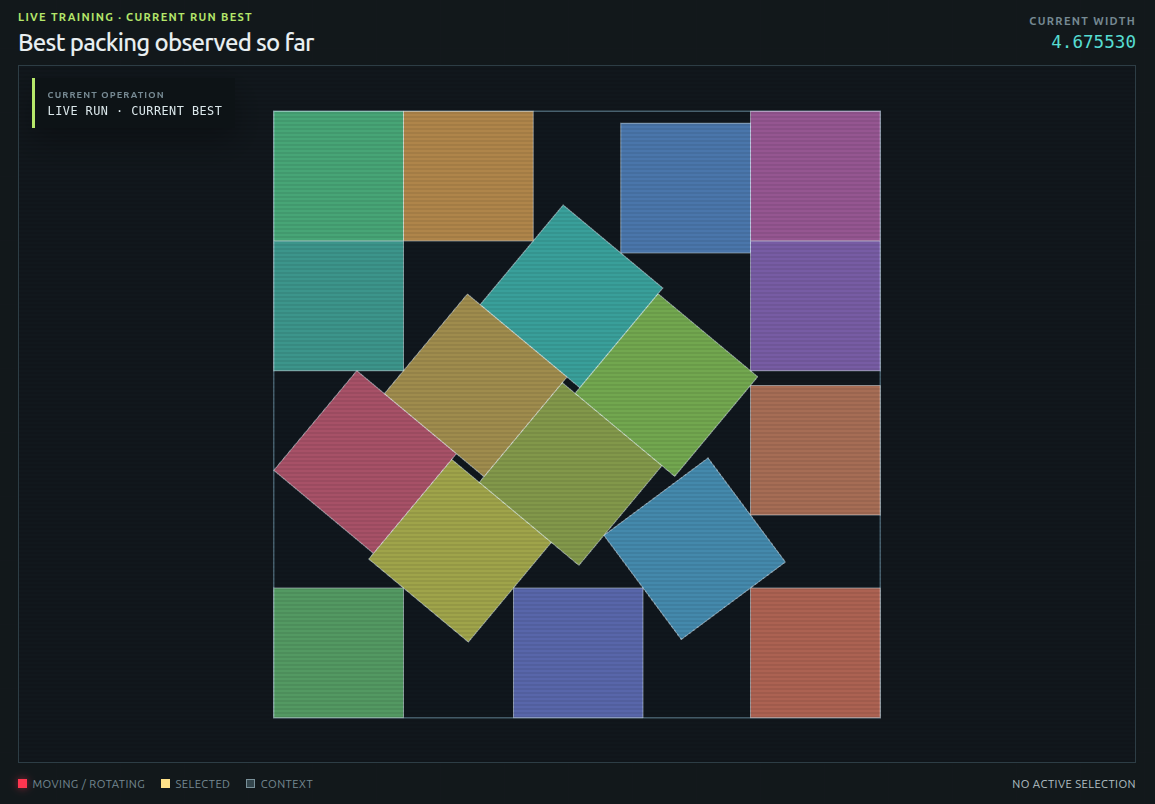
Proposing a Better Lower Bound for n=17 Square Packing
At the start of this project, the strongest published lower bound I could find for packing 17 unit squares into a square was
$$ \frac{40\sqrt 2+19}{17} $$$$ ≈4.445208382 $$This was originally achieved by Trevor Green, and you can find a description of the lower bound here, from Erich Friedman.
This leaves quite a gap between the best known n=17 square packing, and the highest proven lower bound.
ChatGPT 5.6 Sol has been asked to come up with a better lower bound, and proposes a new value of:
$$ 4.4811 $$Nature of the Proof
Rather than assuming that a near-optimal packing resembles any known arrangement, it places a carefully chosen collection of weighted points inside a 4.4811×4.4811 container. It then proves that every possible unit square inside the container must cover at least one unit of weight.
The finite part of the argument is checked by an exact rational verifier. The certificate has 268 weighted atoms with total weight 16.9476, while every translated and rotated unit square is shown to contain weight at least 1.0003. 17 disjoint (i.e. non-overlapping) squares would therefore require more weight than is available.
This is published as a proposed computer-assisted proof, rather than a settled record: the verifier reproduces the result, but the certificate has not yet been independently implemented, audited or peer reviewed. The proof note is credited to ChatGPT (GPT-5.6 Pro, OpenAI), which developed the certificate during this project. I operated.
Files
The Markdown contains the full proof, certificate data, reproduction instructions, audit boundary, acknowledgement and byline.
The Python file is the exact verifier referenced in the proof.
Here are the downloadable files:
I reconstructed and reran the verifier successfully. Its exact minimum was \( 10003/10000=1.0003 \), and it concluded \( s(17)≥4.4811 \).